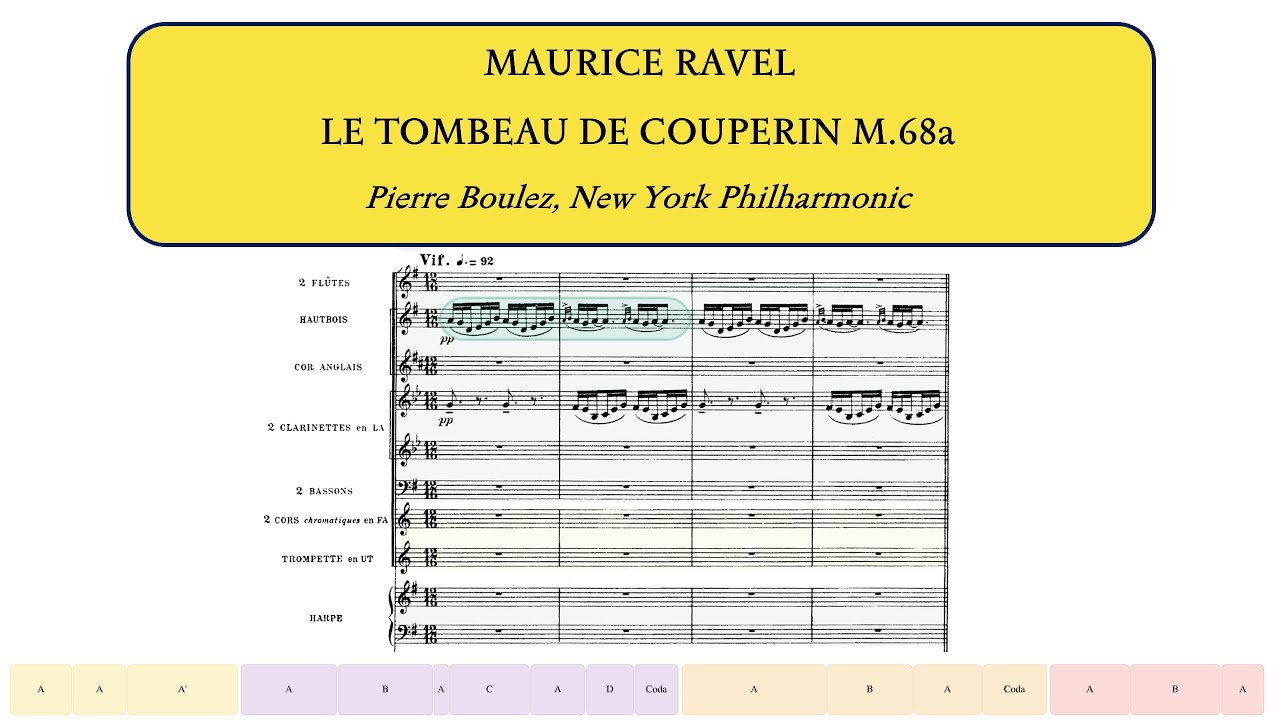
Ravel, Le tombeau de Couperin, M.68a (Orchestral) (Pierre Boulez, New York Philharmonic)
Автор: ScoreMan
Загружено: 2025-10-28
Просмотров: 474
Описание:
M.Ravel's Le tombeau de Couperin (The Tomb of Couperin), M.68a (Orchestra), with with a theme-and-structure analysis and synchronized sheet music (score)
Performance: Pierre Boulez (conductor), New York Philharmonic, 1971/04/27 Stereo, Philharmonic Hall, New York City
Analysis, Score Editing, Synch: ScoreMan
00:00 I. Prélude. Vif
03:11 II. Forlane, Allegretto
09:15 III. Menuet. Allegro moderato
14:19 IV. Rigaudon. Assez vif
OVERVIEW
While the full piano suite (M.68) has six movements, the orchestral version uses four only.
Instrumentation includes a relatively small-sized orchestra with emphasis on winds and harp, which gives transparency and delicacy.
Ravel transformed his piano textures into colourful orchestral sonorities: for instance, the oboe often carries the sarabande-style themes; the harp and winds add Baroque-inspired articulation; strings support with clarity.
The style blends:
Baroque dance-suite forms (Prélude, Forlane, Menuet, Rigaudon)
Impressionist/harmonic colour and modern orchestral brilliance
HISTORICAL CONTEXT
Ravel composed the original suite for solo piano between 1914 and 1917.
The title “Tombeau” refers to a memorial work: Ravel dedicated each movement of the original suite to friends who died in World War I.
In 1919, at the request of his publisher, Ravel orchestrated four of the six movements of the suite.
The movements he orchestrated are: Prélude, Forlane, Menuet, and Rigaudon.
The orchestral version (M.68a) premiered in February 1920 (Pasdeloup Orchestra).
The orchestration reflects Ravel’s experience of the war and his desire to honour the fallen whilst maintaining an elegant, “French” music identity rather than overt pathos.
MUSICAL SIGNIFICANCE
Le Tombeau de Couperin (orchestral) is a cornerstone of neoclassical French orchestral music: it looks back to French Baroque keyboard suites (especially referencing François Couperin) yet speaks with a modern voice.
The orchestration shows Ravel’s mature mastery of tone-colour, transparency, and formal balance.
It demonstrates how tribute/memorial works can be elegant rather than mournful — Ravel himself said he wanted “a farewell tucked into a smile.”
Because of the war context, it also acts as a remembrance piece: each movement honours a friend lost in WWI, but the music stays alive, dance-like, poised.
New Jersey Symphony
In concert repertoire, the orchestral version is more frequently performed than the full piano suite — the orchestral colours add so much to the impact and visibility of the music.
🎹 Mozart Piano Sonatas • Mozart - 18 Piano Sonatas
✨ Beethoven's Masterpieces (sorted by Opus) • Beethoven's Masterpieces
🎶 Beethoven Symphonies • Beethoven - 9 Symphonies
🎹 Beethoven Piano Sonatas • Beethoven - Piano Sonatas
🎹 Schubert Piano Sonatas • Schubert - Piano Sonatas
✨ Chopin's Masterpieces (sorted by Opus) • Chopin's Masterpieces
🎶 Chopin Mazurkas • Chopin - 21 Mazurkas
🎶 Chopin Polonaises • Chopin - 19 Polonaises
🎶 Chopin Nocturnes • Chopin - 22 Nocturnes
🎶 Chopin Waltzes • Chopin - 19 Waltzes
✨ Prokofiev's Masterpieces (sorted by Opus) • Prokofiev's Masterpieces
🎹 Prokofiev Piano Sonatas • Prokofiev - Piano Sonatas
🎹 Piano Sonata Collections • Piano Sonata Collection
🎹 Piano Concerto (Piano & Orchestra) Collections • Piano Concerto Collection
🎻 Violin Concerto (Violin & Orchestra) Collections • Violin Concerto Collection
Повторяем попытку...
Доступные форматы для скачивания:
Скачать видео
-
Информация по загрузке:







![Grieg, Piano Concerto in A minor, Op.16 [Piano Part] (Sviatoslav Richter, Lovro von Matacic)](https://imager.clipsaver.ru/3-pSrU-YzbE/max.jpg)

![Beethoven, Piano Concerto No.2, Op.19 [Piano Part] (Martha Argerich, Boian Videnoff, Mannheimer)](https://imager.clipsaver.ru/GcC8I1uvEmA/max.jpg)